Partial Rewire: Why We Rewired Two Socket Circuits and Left the Rest

Not every job is a full rewire. On this one we rewired just two circuits – the upstairs sockets and the downstairs sockets – lifting floorboards rather than chasing walls to keep the disruption down, and installed a new earth rod outside. The rest of the installation was left alone.
That is what a partial rewire is for. If only part of your wiring needs doing, you should hear that straight, and not be quoted for a whole house.
What is a partial rewire? A partial rewire replaces the cabling on selected circuits, from the consumer unit out to every point on them, and leaves circuits that test sound in place. It is decided by testing, not by the age of the house, and the new circuits are certified the same way as any new installation.
The job: two socket circuits and a new earth
The socket circuits were what needed doing, so the socket circuits were what got replaced: the upstairs sockets and the downstairs sockets, back to the board.
We lifted floorboards to get the new cable in. That avoids cutting channels into plastered walls in every room, which is where most of the mess and redecorating on a rewire comes from.
Outside, we installed a new earth rod and connected it back to the installation. There is more on why that matters further down, because it is the part of this job that nobody sees and the part that does the most for safety.

How we decide between a partial and a full rewire
The question is never “how old is the house”. Plenty of 1970s wiring is in better condition than some 1990s work that has been extended by three different people. The answer comes from testing each circuit and looking at what it is made of.
- Insulation resistance. A low reading on one circuit and healthy readings everywhere else points at that circuit, not the house.
- Cable type. Rubber, lead or fabric-covered cable anywhere means that circuit has had its life. PVC cable in good condition usually has not.
- How the circuit has been altered. Socket circuits get extended more than anything else – an extra double here, a spur there – and poor joints and overloaded spurs build up over the years.
- Earthing and protection. A circuit can be wired well and still be unsafe if the earth is poor or there is no RCD protection.
If the results show a problem spread across every circuit, a full rewire is the honest answer. If they show two circuits in trouble, you rewire two circuits. Our house rewiring page goes through the signs that point towards a full rewire and how we stage one in an occupied home.
An EICR is often how this comes to light. If you have had a report back with codes against particular circuits, our guide to what C1, C2 and C3 codes mean explains what each one asks of you.
Why lifting floorboards beats chasing walls
In most houses the cables for the upstairs sockets run through the floor void between the ground floor ceiling and the first floor boards, then drop down the walls to each socket. Downstairs, on a suspended timber floor, they can often be fed from underneath.
Working through the floor means the new cable follows the same kind of route as the old one. Walls only get opened up where a cable has to drop to a socket, and often the existing drop can be reused. The boards go back down afterwards and, under carpet, nobody can tell.
It is not always possible. Solid concrete floors, fitted flooring that cannot be lifted, or cables that were buried in plaster with no route above or below all change the approach. That is worked out at the survey, so the quote reflects the actual route rather than a guess.
Why the job included an earth rod
Not every property gets a good earth from the supply company. Some supplies do not provide an earth terminal at all, and the installation relies on its own connection to the ground through an earth rod – known as a TT arrangement. In other properties an old earth has deteriorated or was never adequate.
Either way, the earth is what lets a fault clear. When a live conductor touches something metal, current has to flow to earth for the protective device to see the fault and switch off. With a poor earth, that current can be too small to trip anything, and the metalwork stays live.

Fitting an earth rod is not just a case of knocking it in. On another recent job, pictured here, we installed a new rod, connected it back to the board and then tested the earth to make sure it was doing its job. Then we checked every socket was back on and working before we left.
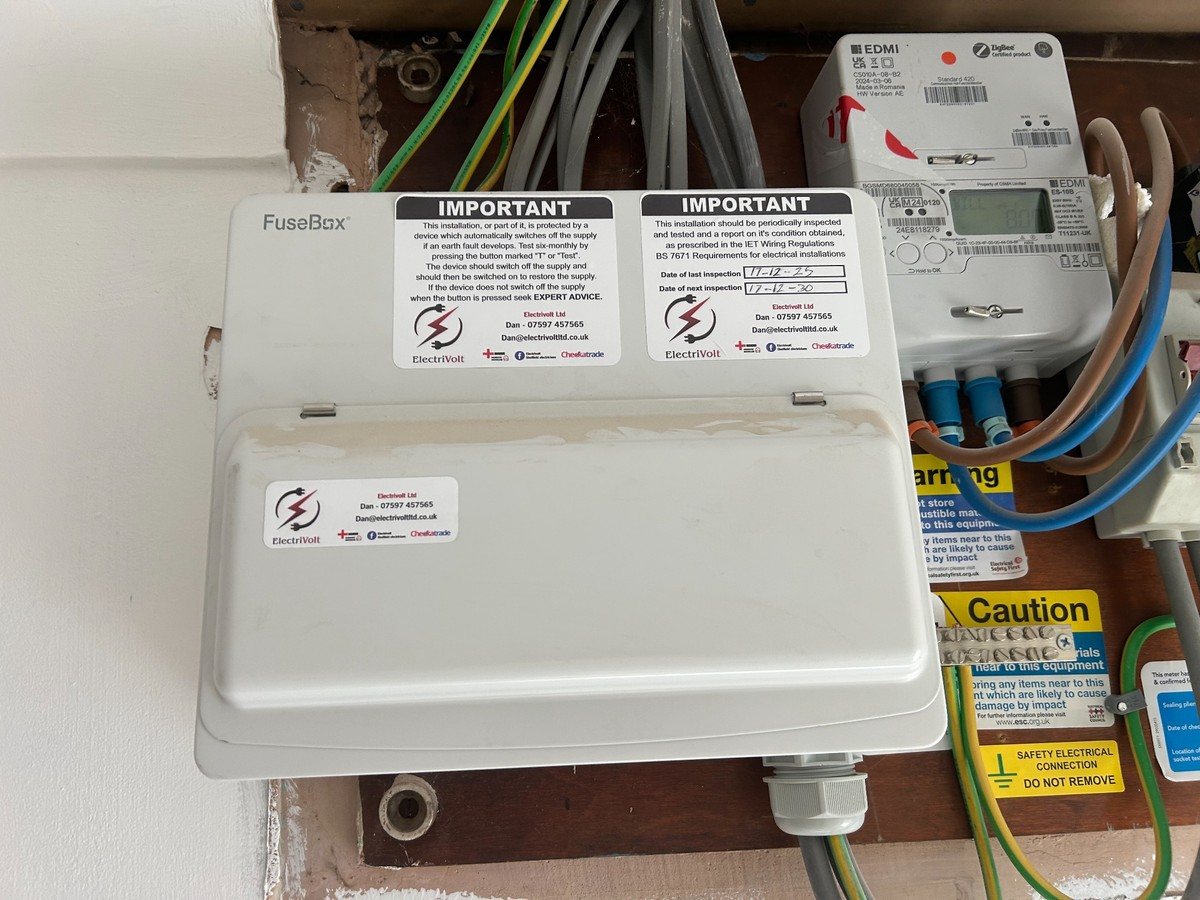
On a TT installation, RCD protection is doing essential work, because the earth rod alone will usually not let enough fault current flow to operate an ordinary breaker. That is one reason the consumer unit gets looked at alongside any rewire.
Worth knowing: new socket circuits need RCD protection. If your board has none, the consumer unit may be part of the job, not an optional extra. Our comparison of RCBO and split-load boards explains what a board change actually gets you.
The paperwork a partial rewire should come with
Replacing a circuit’s cabling back to the board is new circuit work. Regulation 12 of the Building Regulations lists the installation of a new circuit as notifiable electrical work, so it has to be certified and registered with building control.
As a registered installer we do that through our scheme rather than you applying to the council. You should get an Electrical Installation Certificate covering the circuits we installed, with the test results for each one, and the building regulations compliance certificate follows.
Keep both. When you sell, a buyer’s solicitor will ask for them, and a partial rewire with no certificate looks exactly like a DIY job.
What a partial rewire does not fix
A partial rewire makes the circuits it touches as good as new. It does nothing for the circuits it leaves alone, which is fine when they tested well, and is exactly why the testing matters.
If the lighting circuits are on old cable, they are still on old cable afterwards. If the board is a rewireable fuse box, the new circuits still need somewhere suitable to connect to. A good installer will tell you what is left and how long it is likely to be fine, so you can plan the rest rather than be surprised by it.
Frequently asked questions
Is a partial rewire cheaper than a full rewire?
Yes, usually by a long way, because fewer circuits are replaced and less of the house is disturbed. The saving is only real if the circuits being left alone are genuinely sound, which is why the decision should come from testing.
Can I just have the sockets rewired?
Yes, if testing shows the socket circuits are the problem and the rest of the installation is in reasonable condition. That is exactly the job described above. If the lighting circuits are on the same old cable, it may make more sense to do them at the same time while the floors are up.
Do I need to move out for a partial rewire?
Rarely. With only some circuits being replaced, the rest of the house keeps its power while the work goes on, and lifting floorboards rather than chasing walls keeps the dust down.
Why would I need an earth rod?
Some properties do not get an earth from the supply company, and others have an earth that has deteriorated. An earth rod gives the installation its own connection to the ground, so faults can be detected and cleared. It is tested after installation to confirm it works.
Rewires in Sheffield
ElectriVolt rewires houses across Sheffield and within 25 miles – full rewires staged so you can stay in, and partial rewires where only some circuits need doing. Tested before the quote, certified on completion. NICEIC registered and Checkatrade listed.
Get in touch for a free quote or call 07597 457565, Monday to Saturday, 8am to 6pm.


