RCBO Consumer Unit vs Split-Load: What a Fuse Board Upgrade Actually Changes
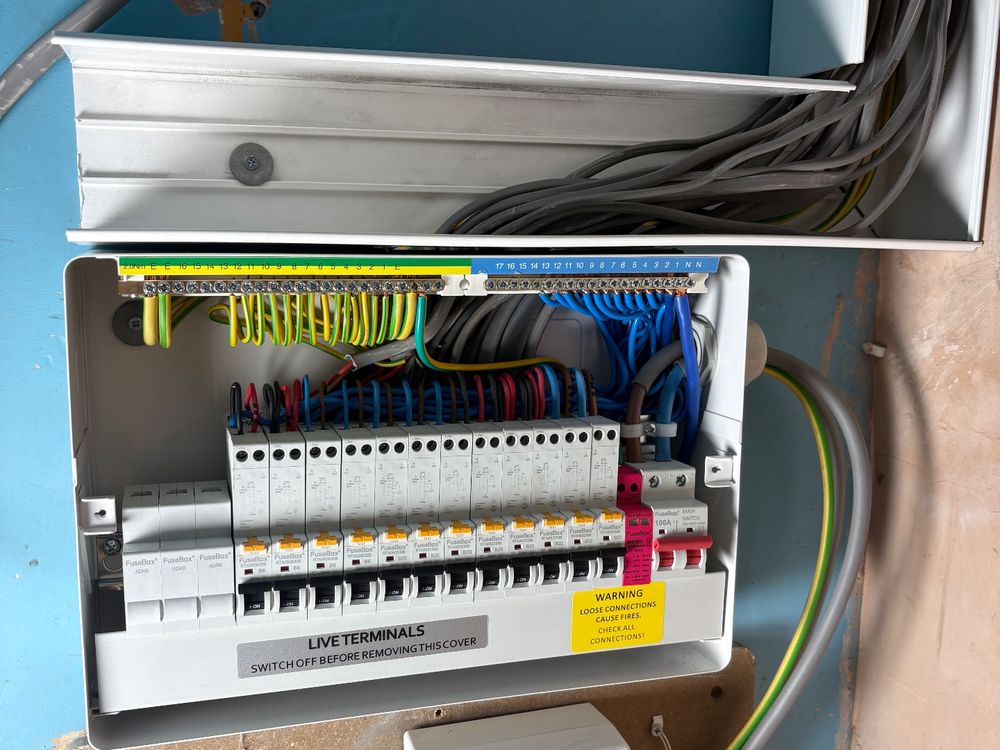
There are only three pieces of electrical work in a house that you have to notify building control about before you start, and replacing the fuse board is one of them. The Building Regulations name all three in a single sentence: installing a new circuit, replacing a consumer unit, or altering an existing circuit inside a bathroom’s shower zone. New sockets, new lights, repairs and replacements sit outside that list entirely.
What does an RCBO consumer unit change? Every circuit gets its own combined breaker and residual current device, so an earth fault trips that circuit alone. On an older split-load board the same fault takes out half the house. Replacing a consumer unit is notifiable building work and has to be certified.
Four generations of board, and how to tell which one you have
Before deciding whether an upgrade is worth it, work out what is actually on the wall. Domestic boards in Sheffield fall into four broad groups, and you can usually identify yours by looking at it for ten seconds.
Rewireable fuse carriers
Pull-out carriers, often grey or black, each holding a length of fuse wire. No switches other than the main one. There is no residual current protection at all on a board like this, and a fault to earth will sit there indefinitely without anything reacting to it.
Miniature circuit breakers, main switch only
A row of small switches that flick down when a circuit is overloaded, with a single main switch and no RCD. Better than fuse wire for overload protection, but still nothing watching for current leaking to earth.
Split-load, two RCDs
Two large test-button devices, with the breakers grouped into two banks either side. This was the standard domestic arrangement for years. Each RCD covers roughly half the circuits in the house.
All-RCBO
Every breaker is slightly wider and has its own test button. There is no shared RCD because each circuit carries its own combined overload and earth-fault protection.
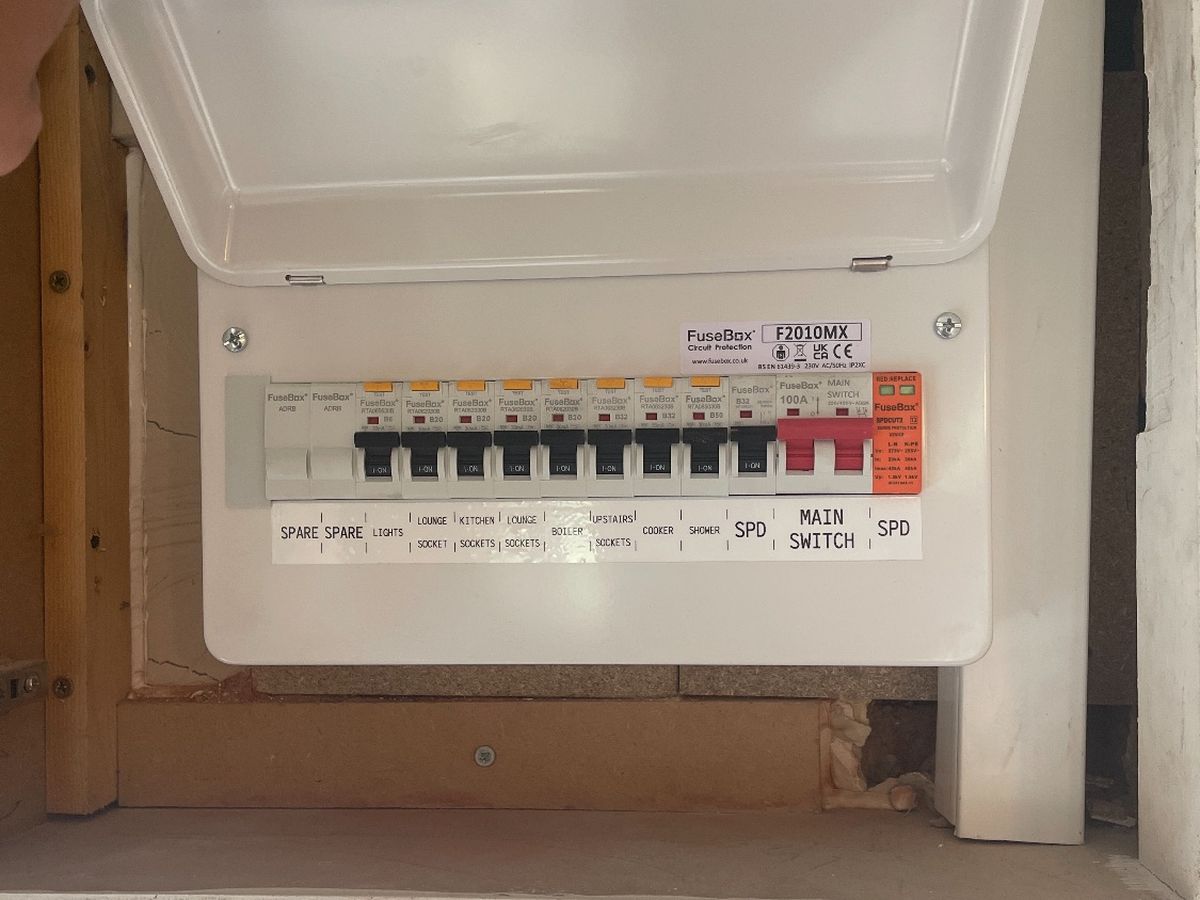
What an RCBO consumer unit changes that a split-load board cannot
Strip away the terminology and there is one practical distinction between a split-load board and an all-RCBO board, and it is not safety. Both give the circuits the same residual current protection, because in domestic work the devices used are 30mA rated either way. What differs is the blast radius when something goes wrong.
On a split-load board, a failing kettle element on the downstairs sockets trips the RCD covering that whole bank. That can take out the downstairs sockets, the freezer, the boiler and the upstairs lighting in one go. If it happens while you are away, you come home to a warm freezer and no obvious explanation.
On an all-RCBO board, the same fault trips the socket circuit the kettle is plugged into. Everything else stays on, and the tripped breaker tells you immediately which circuit to look at.
There is a second, quieter benefit. Every appliance leaks a tiny amount of current to earth by design – it is inherent in filters and switch-mode power supplies. On a split-load board those small leakages add up across every circuit on one RCD, and a house with plenty of electronics can sit close to the trip threshold with nothing actually faulty. Add a washing machine at the end of its life and the board trips “for no reason”. Splitting the circuits onto individual RCBOs removes that cumulative effect.
What the regulations require when the board is changed
Replacing a consumer unit is not like changing a light fitting. Regulation 12 of the Building Regulations 2010 requires a building notice or an application for building control approval where the work consists of the installation of a new circuit, the replacement of a consumer unit, or any addition or alteration to existing circuits in a special location.
In practice, almost nobody submits a building notice for a board change, because there is a shorter route. Approved Document P sets out three ways notifiable work can be certified: self-certification by a registered competent person, third-party certification, or certification by a building control body.
Where the electrician is a registered competent person, they complete a BS 7671 electrical installation certificate for the job and hand it to whoever ordered the work. Their registration body then has to give the occupier a Building Regulations compliance certificate within 30 days, and send the same information to the building control body.
That second certificate is the one people forget about and then need years later. It is the document a conveyancing solicitor asks for when the house is sold, and the record that the work was ever certified at all. If a board was changed without it, there is nothing to produce. Approved Document P also makes the point that local authorities can take enforcement action where work is unsafe and non-compliant, whether or not it was notifiable.
The practical version: ask for both certificates, keep them with the deeds, and be suspicious of any board change where neither is mentioned. Our consumer unit and fuse board page sets out what we issue on completion.
What a new board does not fix
This is the part that gets oversold, so here is the honest position: a consumer unit upgrade protects the circuits it feeds. It does not improve them.
A new board will not repair perished rubber or fabric-insulated cable in a 1950s installation. It will not create an earth conductor in lighting circuits that were wired without one. It will not resolve borrowed neutrals between circuits, and it will not upgrade an undersized main earthing conductor or absent main protective bonding to the incoming water and gas services – though a competent installer will pick those up and price them as part of the job, because leaving them is not an option.
Put differently: an RCBO board on a tired installation makes the existing faults visible rather than making them go away. That is a genuine improvement in safety, but it is not the same as a sound installation, and anyone telling you a new board “brings the house up to standard” is skipping several steps.
The sensible order is testing first, board second. An electrical installation condition report tells you the state of the circuits and whether a board change is the right intervention or the cheapest-looking one. Where the report finds cable at the end of its life, the conversation moves to a rewire, in stages if that suits better.

Why a new board sometimes trips when the old one never did
This catches people out badly, and it is worth understanding before the work starts rather than after.
An old board with rewireable fuses has no residual current protection whatsoever. A circuit with damp in a buried cable, a nail through a cable in a floor void, or a damaged immersion heater element can leak current to earth for years without anything in the house reacting to it. Nothing trips, so nothing appears to be wrong.
Fit RCBOs on those same circuits and the leakage is detected the moment the board is energised. The circuit trips, and it looks as though the new board has caused a problem it has actually just revealed.
That is why insulation resistance testing before the quote matters. Testing each circuit first identifies which ones will not hold up, so the faults can be priced and repaired as part of the job rather than discovered with the old board already in a bin bag and the family with no power. Any board change quoted without testing first is a quote with an unknown attached.
Where a fault does need chasing, that is separate diagnostic work – our fault finding page explains how we approach it.
Where the board goes, and who needs to reach it
Position matters more than people expect, because the main switch is what someone reaches for in an emergency.
Approved Document P notes that one way of complying with Part M in new dwellings is to mount consumer units so the switches sit between 1350mm and 1450mm above finished floor level – high enough to be out of reach of young children, low enough to be operated standing or sitting. That recommendation is written for new dwellings, not for retrofits, but it is a sound benchmark when a board is being relocated anyway.
In older Sheffield housing the reality is often a board in a cellar head, under the stairs, or in a cupboard above a worktop. Relocating it during an upgrade is frequently possible and frequently worth it – but it means extending or re-terminating every circuit cable, so it belongs in the conversation at quote stage rather than on the day.
Is it worth changing a board that works?
A consumer unit is not a car part with a service interval, and “it is old” is not on its own a reason. Change it for a reason you can name. These are the ones that hold up.
- No residual current protection at all. Rewireable fuses, or breakers with no RCD. This is the strongest case there is.
- Any sign of heat. Discolouration around terminals, a smell of hot plastic, or a breaker that is warm to the touch.
- An obsolete board. If replacement breakers for it are no longer made, a single failure becomes a whole-board job at the worst possible moment.
- C2 codes on an inspection report tied to the board itself. Those have to be remedied, and a patch repair on a board of that age is often the false economy.
- Planned work with nowhere to put it. An EV charger, an electric shower or a kitchen refit all need a way at the board and correct protection. No spare ways, or no RCD, forces the issue.
- Repeated nuisance tripping on a split-load board with no fault ever found – the cumulative leakage problem described above.
If none of those apply, a board that is sound, protected and has spare capacity can reasonably be left alone and reassessed at the next inspection.
One thing most guides get wrong: a consumer unit upgrade is sold as if it certifies the house. It does not. The certificate that comes with it records that the board and the circuits were tested on the day – which is genuinely useful, and is not the same as the installation being in good condition. Read what the certificate actually says, including the observations.
Frequently asked questions
Is replacing a consumer unit notifiable?
Yes. It is one of three categories of notifiable electrical work named in the Building Regulations, alongside installing a new circuit and altering an existing circuit in a special location. It has to be certified, either by a registered competent person self-certifying, a third-party certifier, or building control.
What is the difference between an RCBO and an RCD?
An RCD detects current leaking to earth and disconnects, but it does not protect against overload – so on a split-load board it sits upstream of several ordinary breakers and covers them all together. An RCBO combines both functions in one device for one circuit, so only the faulty circuit disconnects.
Do I need a new consumer unit to have an EV charger fitted?
Not always. It depends on whether there is a spare way, whether the existing board provides suitable protection, and what the main supply and earthing arrangement will support. That gets confirmed by survey rather than assumed either way.
How long does a consumer unit replacement take?
Most domestic board changes are a full day’s work with the power off for a large part of it, because every circuit is tested and recorded as it is reconnected. Plan around having no power rather than expecting it back at lunchtime, and move anything critical in the freezer beforehand.
Consumer unit upgrades in Sheffield
ElectriVolt replaces fuse boards and consumer units across Sheffield and within 25 miles – tested before the quote, certified on completion, with the compliance certificate following. NICEIC registered and Checkatrade listed, with a workmanship guarantee.
Get in touch for a free quote or call 07597 457565, Monday to Saturday, 8am to 6pm.


