Electrical faults traced, not guessed at.
Tripping breakers, dead sockets, flickering lights and burning smells. We test to find the actual cause rather than replacing parts until something changes.
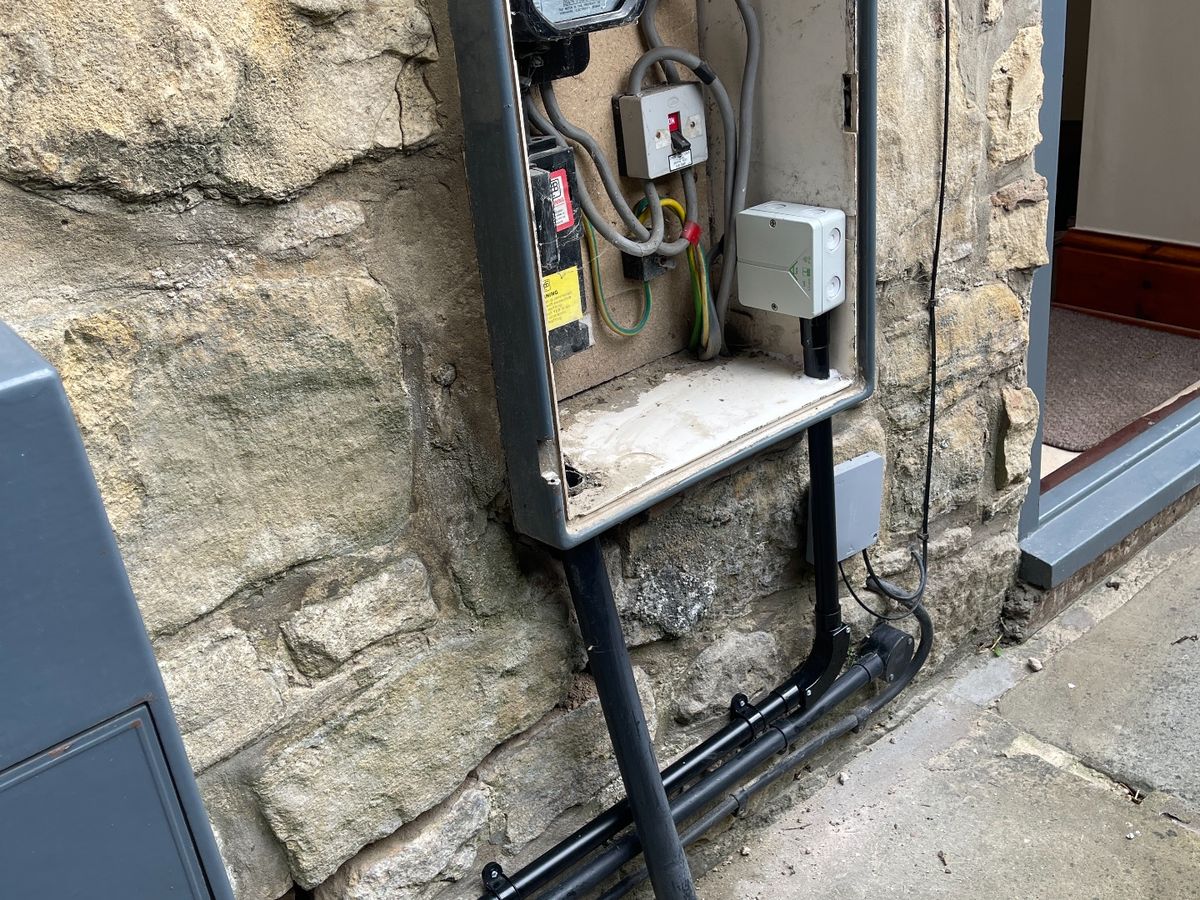
Deal with this now, not tomorrow
A burning smell, scorch marks around a socket, or anything warm to the touch means switch that circuit off at the consumer unit and call. Same goes for a shock or tingle from an appliance or a tap. These are the ones that don’t wait — we take urgent callouts Monday to Friday within working hours. See emergency callouts.
Other symptoms are annoying rather than dangerous, but they’re still the installation telling you something: a breaker that trips every few days, lights that dim when the kettle goes on, a socket that only works sometimes.
How a fault actually gets found
Electrical fault finding is a process of division. Rather than replacing parts and hoping, the circuit gets split and tested section by section until the fault is isolated to one accessory, one cable or one appliance.
What that involves
- Establishing what changed and when — new appliance, recent work, wet weather, a specific time of day.
- Insulation resistance testing to find breakdown between conductors, which is what most persistent RCD trips turn out to be.
- Splitting the circuit at junctions to halve the search area each time.
- Testing appliances separately, because a good proportion of “circuit faults” are a faulty appliance rather than the wiring.
Intermittent faults are the hard ones, and honest expectation-setting matters: a fault that appears twice a month may not appear while we’re there. In that case we narrow it down as far as testing allows and tell you what we’ve eliminated, rather than charging for a fix that might be a guess.
The usual culprits
RCD tripping
Normally moisture or a deteriorating appliance element — immersion heaters, ovens, washing machines and outdoor sockets are the regulars. On older split-load boards one fault takes out half the house, which is why individual RCBOs make faults easier to live with as well as easier to trace.
Dead sockets
Usually a loose connection at a socket further up the ring, often one that’s been disturbed by flooring or furniture. It’s rarely the socket that’s dead that’s at fault.
Dimming and flickering
Sometimes a lamp or driver, sometimes a poor connection carrying more resistance than it should. The second one warms up, which is why it’s worth looking at rather than living with.
What you get
We tell you what the fault was, where it was and what caused it — and where it points to something broader, we’ll say so. Repeated faults on multiple circuits in an older property usually mean it’s worth having an EICR to see the whole picture rather than fixing them one at a time.

Things people ask
Do you charge a callout fee?
No. Quotes are free and there’s no charge for coming to look. Fault finding itself is chargeable work because it’s diagnostic time, and we’ll agree that with you before starting.
How quickly can you come out?
Urgent callouts run Monday to Friday within working hours. Anything involving burning smells, scorching or shocks gets treated as urgent — switch the circuit off at the consumer unit and ring rather than emailing. Outside those hours, isolate the circuit and leave a message; see emergency callouts.
Can you fix it the same visit?
Often yes, if it’s a connection, an accessory or a faulty appliance. Faults needing a cable replaced in a wall or floor sometimes need a second visit. You’ll know which it is once it’s traced.
What if the fault doesn’t happen while you’re here?
Intermittent faults are genuinely harder. We test what we can, eliminate what we can, and tell you honestly what’s been ruled out and what hasn’t. We won’t invent a fix to close the job off.
Other work we take on.
Full & partial rewires
Older properties brought up to current standards, room by room or all at once.
Learn more →
Consumer unit upgrades
Old fuse boards replaced with modern RCBO units, tested and certified.
Learn more →
Guides on Fault Finding & Callouts.
 Why Does My RCD Keep Tripping? How to Narrow It Down Before You Call an ElectricianAn RCD trips because it has seen current leaking where it should not. The usual causes, how to narrow it…6 October 2026 · 10 min read
 Bathroom Spotlights and LED Lighting: Wire It Before the Tiles Go UpBathroom lighting has to be wired at first fix. A real bathroom job with spotlights on a dimmer, LED strips…27 September 2026 · 6 min read
 RCBO Consumer Unit vs Split-Load: What a Fuse Board Upgrade Actually ChangesAn RCBO consumer unit gives every circuit its own protection. Here is what a fuse board upgrade changes, what it…17 September 2026 · 10 min read