Bathroom Spotlights and LED Lighting: Wire It Before the Tiles Go Up
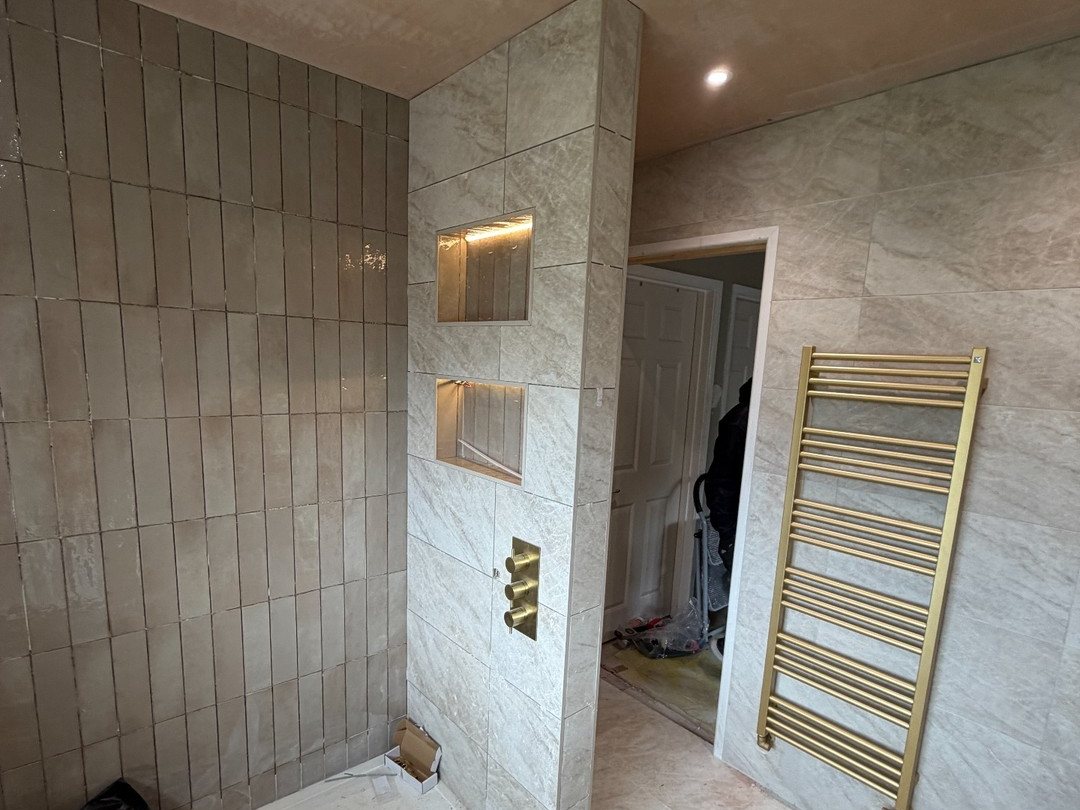
Bathroom lighting is decided before a single tile goes up. Once the walls are finished, moving a spotlight or adding a lit niche means taking tiles off. So on this bathroom we did the first fix while the room was stripped back to the joists: LED spotlights on a two-gang dimmer, LED strips in the shower niches and around the boxing, a supply for the mirror light and a shaver point, and an extractor fan with its own switch.
The finished room shows why it is worth getting in early – warm light in the niches, a heated towel rail, and spots set out exactly where the client wanted them.
When should bathroom lighting be wired? At first fix, while the walls and ceiling are open and before plastering or tiling. Every spotlight, LED strip, mirror light and switch position needs its cable in place by then, and fittings have to suit the bathroom zone they sit in. Anything added afterwards means cutting into finished surfaces.
The job: a full bathroom from bare walls
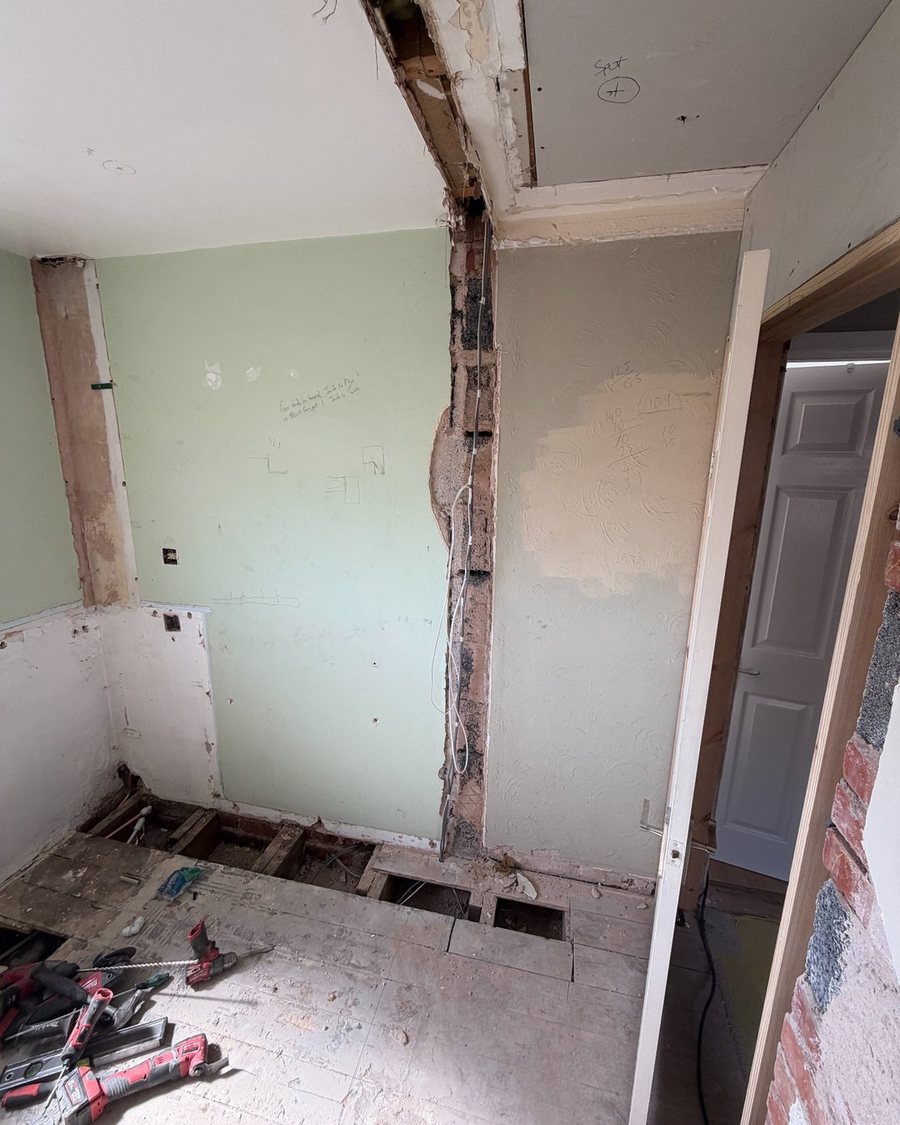
This is where the room started. With the old finishes off and the floor open, every cable route was available, which is exactly when lighting should be planned.
The ceiling spots went on a two-gang dimmer, and LED strips went into the shower niches and around the boxing. Having more than one lighting control in a bathroom is what lets the same room be bright for cleaning and shaving, and low and warm for a bath.
LED strips in shower niches
A lit niche is one of the most effective things you can do in a modern bathroom, and one of the easiest to get wrong. It only works if it is planned into the tiling, because the strip sits in a channel or behind a lip so you see the glow rather than the individual LEDs.

A few things matter with LED strips in a wet room:
- The strip has to be rated for where it sits. A niche inside a shower gets sprayed directly, so the strip needs a suitable water rating.
- The driver goes somewhere you can get to. LED strips run from a driver, and drivers fail more often than strips do. It goes in an accessible place outside the wet zones, not sealed behind tiles.
- It needs to work with the dimmer. Strips, driver and dimmer have to be compatible, or you get flicker and buzzing at low settings.
Bathroom zones and what they mean for fittings
Bathrooms are divided into zones based on how close you are to water. Zone 0 is inside the bath or shower tray, zone 1 is directly above it, and zone 2 is the area immediately around it. Outside those zones the rules relax, but the room is still treated as a special location.
Light fittings in zones 1 and 2 need an ingress protection rating against water, with IPX4 as the usual minimum. Spots over a shower are normally chosen with a higher rating to be safe. Downlights cut into a ceiling with a room above should also be fire-rated.
Electrical Safety First points out that all circuits in or passing through bathrooms or shower rooms are now required to be protected by an RCD. If your board has no RCD protection, that needs sorting as part of the bathroom, not after it.
Mirror lights and shaver points
An illuminated mirror needs its supply in exactly the right place, because the cable has to disappear behind the mirror. That means knowing the mirror, or at least its size and fixing height, before the wall is boarded.
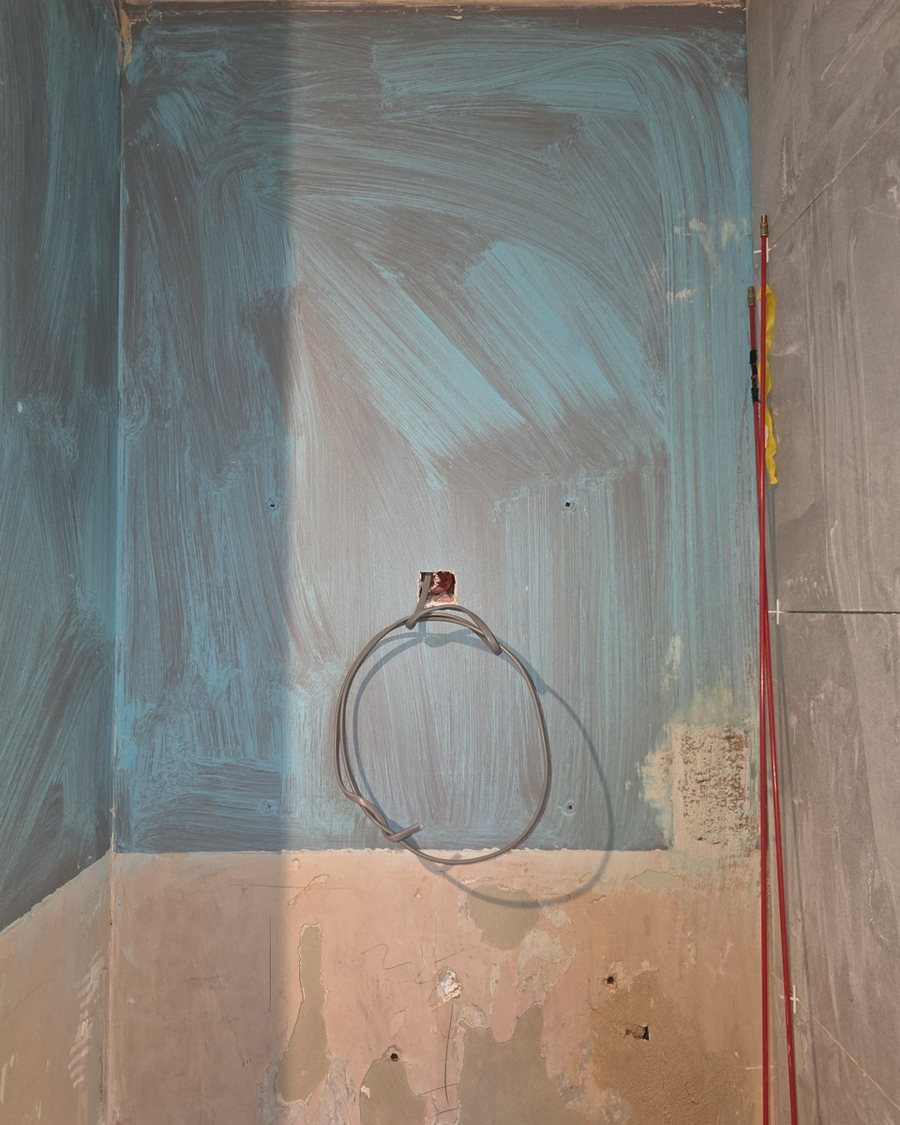
On another recent job we ran new supplies for illuminated mirrors in both the main bathroom and the en suite, with the cables left in place ready for second fix once the walls were finished. The same applies to shaver points, which need a dedicated shaver supply unit rather than an ordinary socket.

Is bathroom electrical work notifiable?
Some of it is. The Building Regulations make any addition or alteration to existing circuits in a special location notifiable, and the space around a bath or shower is a special location. A new circuit is notifiable wherever it is.
In a full bathroom refit, that covers most of the work. As a registered installer we certify and notify it through our scheme, and you get the certificate at the end. The extractor fan comes under the same work, and our guide to extractor fan regulations covers what Part F and Part P ask of it.
Colour and brightness in a bathroom
Bathrooms are used for two very different things. Shaving, make-up and cleaning need bright, even light with no shadows on your face. A bath at the end of the day needs almost the opposite. Getting both from one room comes down to layers.
- Ceiling spots give the general light. Placed over the basin and in front of the mirror rather than in a neat grid, they light your face instead of the top of your head.
- The mirror light gives the most useful light for shaving and make-up, straight on and without shadows.
- Niche and plinth strips give the low, warm light for a bath, and make a good night light on their own.
Keep the colour temperature consistent across the fittings. Warm white spots with cool white strips looks like a mistake, even when each fitting is fine on its own. If you want to choose fittings yourself, tell us the model before first fix so the right cables, drivers and dimmers go in.
What happens at second fix
Once the tiling and decorating are done, we come back to fit everything that needs the finished surfaces: spotlights into the ceiling, switches and the dimmer on the wall, the shaver point, the extractor fan and the mirror. Then every circuit is tested, the RCD is checked, and the installation is certified.
If the plan changed between first and second fix – a different mirror, a moved basin – tell us as early as possible. Sometimes it is a small adjustment. Sometimes the cable is now in the wrong place behind a tiled wall, which is the whole reason first fix is planned carefully.
Get the electrician in before the tiler
The order on a bathroom refit is strip out, first fix plumbing and electrics, boards, tiling, then second fix. If the electrician comes after the boards are up, lighting choices get limited to what can be reached without cutting. Our lighting installation page covers how we plan layouts, colour temperature and dimming for every room.
Frequently asked questions
Can you have spotlights above a shower?
Yes, as long as the fittings are rated for the zone they are in. Over a shower that means a suitable IP rating against water, and fire-rated fittings if there is a room above.
Do bathroom lights need to be on an RCD?
Yes. All circuits in or passing through a bathroom or shower room need RCD protection.
Can you put a normal socket in a bathroom?
Only where it can be at least 2.5 metres from the edge of the bath or shower tray, which rules it out in most UK bathrooms. Shaver supply units are the exception and can go closer.
Can LED strips be used in a shower niche?
Yes, if the strip is rated for water and the driver is fitted somewhere accessible outside the wet zones. It needs planning before tiling, because the strip is usually set into the niche.
Bathroom and lighting installation in Sheffield
ElectriVolt wires bathrooms and lighting across Sheffield and within 25 miles – planned at first fix, certified on completion. NICEIC registered and Checkatrade listed, with a workmanship guarantee.
Get in touch for a free quote or call 07597 457565, Monday to Saturday, 8am to 6pm.


